
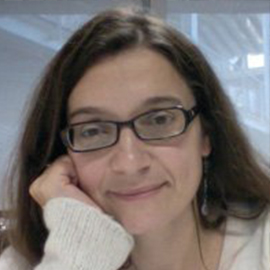
Chrysoula Pitsouli
Chrysoula Pitsouli is an Associate Professor at the Department of Biological Sciences of the University of Cyprus and leads the Drosophila Development and Homeostasis Laboratory since 2012.
She was trained in cell signaling, Drosophila genetics, molecular biology and microscopy during her graduate studies at the University of Crete, while studying the role of endocytosis in the cell communication pathways that drive pattern formation and neuronal primordial specification. During her postdoctoral fellowship at Harvard Medical School, she pioneered work on tubular organ developmental remodeling in Drosophila, introduced pathogenic bacteria in studies of intestinal regeneration and she was involved in establishing genetic and imaging techniques.
In her lab at the University of Cyprus, Chrysoula uses Drosophila to understand development, homeostasis and disease and how these processes are controlled by genes, the environment and diet at the molecular and cellular levels. Recently completed lab projects have assessed the role of genetics (Evangelou et al., G3: Genes, Genomes, Genetics, 2019), intestinal infection, ROS and hypoxia (Tamamouna et al., Development, 2020; Tamamouna et al., Nature Cell Biology, 2021), as well as microbiota and diet (Neophytou and Pitsouli, Cell Reports, 2022) on stem cell mediated intestinal tissue remodeling and tissue communication upon homeostasis and tumorigenesis. Ongoing work addresses cell-cell signaling, the role of specific genes and nutrients on intestinal regeneration and tumor growth, glioblastoma-trachea communication, developmental remodelling of oxygen-transporting vessels and subcellular tube growth upon hypoxia. Chrysoula has received funding from the Greek Secretariat of Research, EMBO, Marie Sklodowska-Curie, the Fondation Santé and the Cyprus Research and Innovation Foundation. In addition to teaching undergraduate and graduate students at the Department of Biological Sciences, she has trained two postdocs, 6 PhD students (4 ongoing), 10 MSc students and 17 undergraduate diploma students. She has authored 14 research papers and 8 reviews and book chapters in highly visible scientific journals.